AI Security
What an AI certificate actually certifies
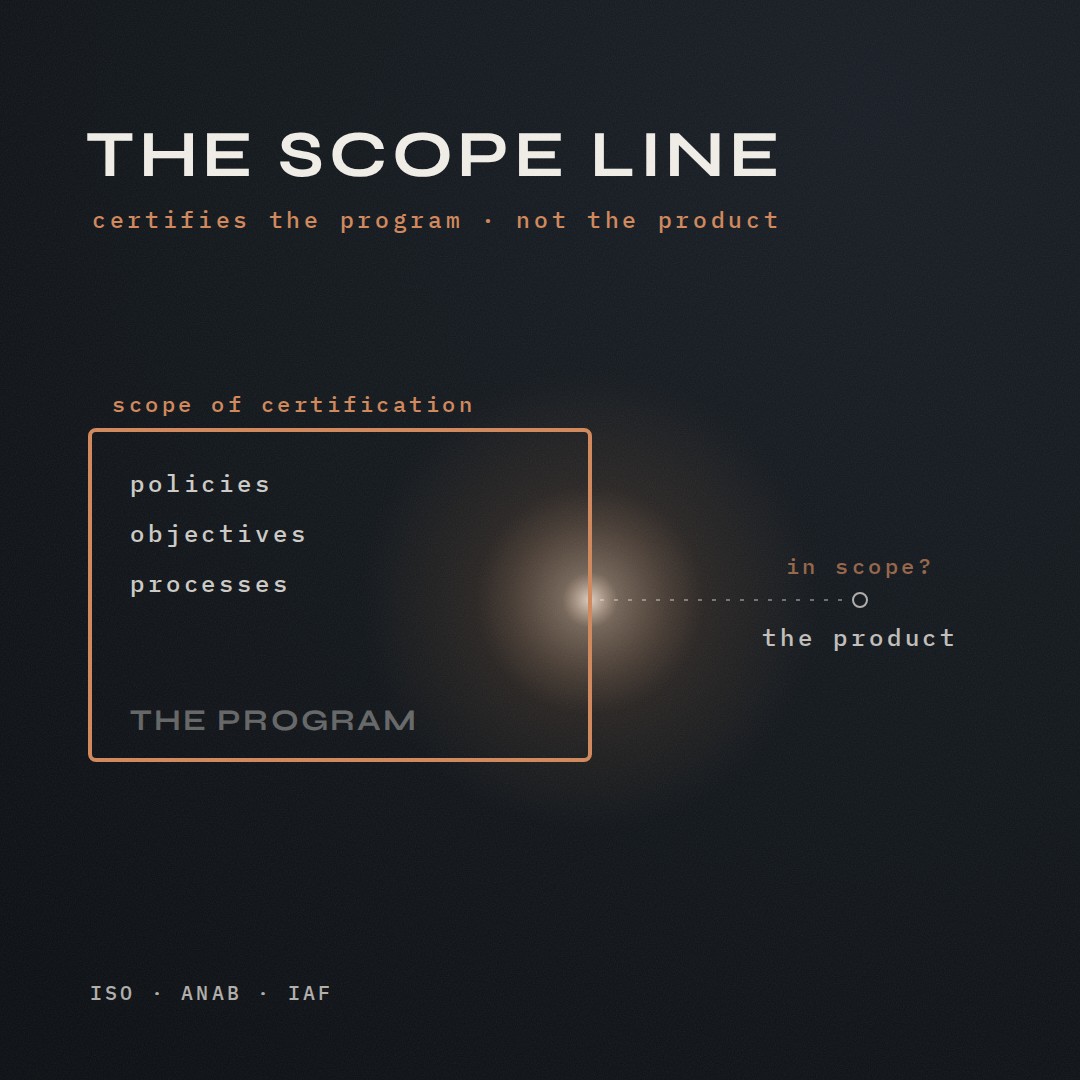
An ISO/IEC 42001 certificate certifies the program.
It does not certify the product.
Last time, the AI management-system standard, ISO/IEC 42001, stayed on the honest side of a simple line: nothing ISO says about it promises that a model can be made immune to injection. Its certificate inherits that honesty, and that limit.
Start with who issues it. “ISO does not perform certification or issue certificates,” ISO says. Independent certification bodies do, and ISO defines certification as “written assurance” that “the product, service or system in question meets specific requirements.”1 For 42001, the system is a management system, an organization’s way of running AI responsibly. In ISO’s words, it is a set of elements intended to establish “policies and objectives, as well as processes to achieve those objectives.”2 In July 2025, ISO published a companion standard, ISO/IEC 42006, which adds requirements for the bodies that audit and certify it.3
So a 42001 certificate says a certification body audited the organization’s AI management system, within a stated scope, and judged that it conforms to the standard. That is worth something. It is not a statement that the assistant inside the product you are buying will refuse the instruction hidden in tomorrow’s email. A management-system certificate does not claim that, and as the last post showed, no known method can guarantee it.
A driver’s license proves someone passed the test. It says nothing about the text message at the next red light. And it expires.
Three questions turn a logo into evidence. Each narrows the claim, and they work for any management-system certificate, 42001 or 27001.
What is in scope? A certificate should name the company it was issued to, the scope of certification, the standard and its version, the issuer, and the dates it was issued and expires.4 Ask for the certificate, not the badge. Check that the entity on your contract and the product you are buying are both inside it.
Who issued it, and is that body accredited for this standard? “Accreditation is not compulsory,” ISO notes, and its advice to organizations choosing a certifier is to “check if it is accredited.”1 A buyer can run the same check. The International Accreditation Forum’s CertSearch database can show whether a certificate is valid, whether its issuer is accredited for that standard, and whether it has been suspended or withdrawn.5 The certification body itself can also confirm it.4
Scope and issuer tell you the certificate is real. The last question tells you what it is real about. What does it leave out? A management-system certificate speaks to the program. Some AI certifications, such as HITRUST’s, assess security controls on specific AI platforms and deployed systems;6 read their scope the same way. For the product, ask what this AI can reach, what it can send out, and who approves it. If the product sits outside the scope, those answers and your contract are what you have.
For vendors, publishing the scope answers the buyer’s first question before it is asked. A narrow scope, published, is stronger evidence than a broad one implied.
When a vendor hands you a certificate, who in your organization reads the scope line?
Notes
- International Organization for Standardization, “Certification,” accessed September 23, 2026, www.iso.org/certification.html. ↩a ↩b
- International Organization for Standardization, “ISO/IEC 42001:2023: AI Management Systems,” accessed September 23, 2026, www.iso.org/standard/42001. ↩
- International Organization for Standardization, “ISO/IEC 42006:2025: Requirements for Bodies Providing Audit and Certification of Artificial Intelligence Management Systems,” accessed September 23, 2026, www.iso.org/standard/42006. ↩
- ANSI National Accreditation Board, “What to Look for on a Certificate,” accessed September 23, 2026, anab.ansi.org/about-anab/what-to-look-for-on-a-certificate/. ↩a ↩b
- International Accreditation Forum, “IAF CertSearch: A Global Database for Verification of Accredited Management Systems Certifications,” IAF Outlook, August 30, 2023, iaf.news/2023/08/30/iaf-certsearch-a-global-database-for-verification-of-accredited-management-systems-certifications/. ↩
- HITRUST Alliance, “HITRUST Launches AI Security Assessment with Certification Setting Benchmark for AI Security Assurance,” press release, November 19, 2024, hitrustalliance.net/press-releases/hitrust_launches_ai_security_assessment_and_certification. ↩